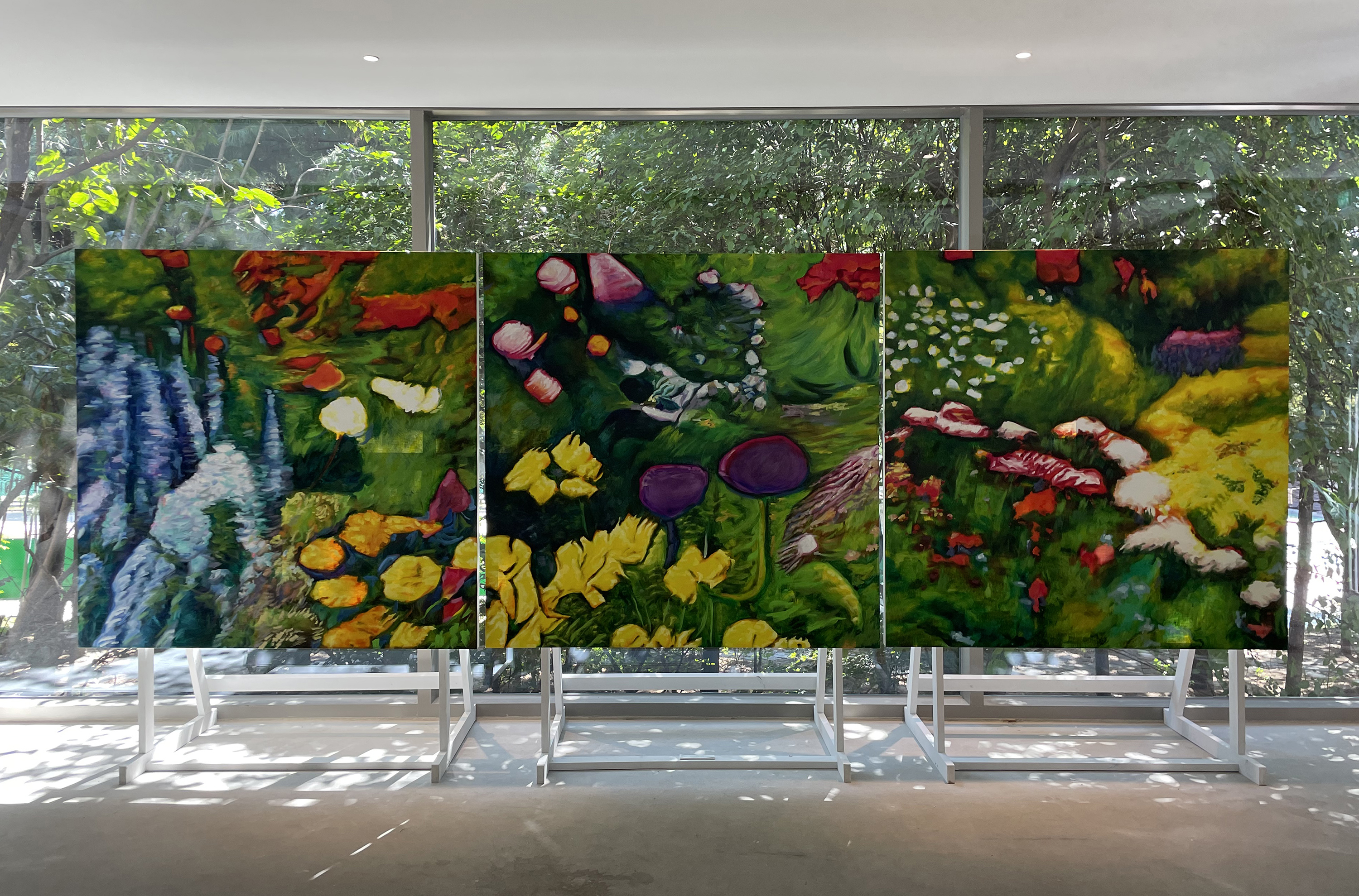
Show me an oil painting most beautiful and good place for human to live (prompt)
Show me an oil painting most beautiful and good place for human to live (prompt), 2022, oil on canvas, based on an AI-generated image (CrAlyon), 150 × 150 cm
Exhibitions:
Random Access Memory, Chapter 1: Displacement 0 (Zero), Plad, Gallerie X, 2022
WWD Korea ART GALA, 2022
OpenAI에서 최초의 이미지 생성 모델인 달리(DALL·E)가 공개되었다. 이완은 베타 테스터로 참여하며 이미지 생성 인공지능의 초기 버전을 경험했다. 초기의 이미지 생성 AI는 기술적으로 조악했지만, 사용자의 의도를 일정 부분 반영한 이미지를 생성할 수 있었다. 이는 인간의 내면에 떠오른 형이상학적 이미지가 언어를 매개로 인공지능에 의해 다시 이미지로 번역되는 과정이었다.
작가는 앞으로 인간이 떠올린 이미지를 언어로 전달하고, 인공지능이 생성한 이미지 중 하나를 인간이 선택하는 과정이 반복될수록, 인공지능은 인간의 내면적 이미지에 점점 더 근접해 학습하게 될 것이라 보았다. 인공지능은 인간의 생각과 감각의 움직임을 완벽하게 재현한다기보다, 그것에 끊임없이 접근하며 추적하는 기술로 발전할 것이다.
이완은 인공지능에게 ‘표류하는 인간들이 도달할 가장 아름답고 살기 좋은 곳’을 그려달라고 요청했고, 생성된 이미지를 출력해 미술을 전공한 숙련된 노동자에게 유화로 다시 그리도록 의뢰했다. 인공지능 시대에 누구나 이미지를 생성할 수 있게 되면서, 이미지를 상상하고 구현하는 단계의 창의성은 더 이상 예술가만의 전유물이 아니게 되었다. 타고난 재능과 오랜 훈련을 통해 가능했던 표현 행위는 인공지능을 통해 누구에게나 열리게 되었고, 창의성은 민주화되었다.
이에 따라 예술은 더 이상 이미지의 생산 자체에 머무르지 않고, 무엇을 선택하고 어떻게 배치하며 어떤 감각을 남길 것인가라는 보다 개념적이고 감각적인 영역으로 이동하게 된다. 반대로 표현을 물질로 구현하는 기술은 더욱 숙련된 장인의 영역으로 이동하며, 인간의 손을 통해 만들어진 물건과 예술품은 새로운 가치를 획득한다.
작가는 이러한 변화 속에서 예술적 표현이 노동의 개념으로 확장되어 교환의 영역에 편입되는 동시에, 예술이 철학과 과학 사이로 이동해 감각의 구현과 감각의 전이에 관여하는 역할로 재배치될 것이라 말한다. 인공지능 시대의 예술은 더 이상 결과물을 만드는 행위가 아니라, 무한한 잠재성 속에서 감각과 의미를 선택하고 조율하는 행위가 될 것이라고 말한다.
이 작업은 이러한 의미에서 상당히 중요한 지점을 파고든다. 이전 평면작업 시리즈 ‘무의미한 것에 대한 성실한 태도’가 자본주의 시스템 안에서 노동자들을 고용해 노동을 통한 이미지를 만들어냈다면 이번 작업은 숙련된 프리랜서 예술가를 고용해 포스트포디즘적 노동을 끌어들여 만들어진 이미지다. 인공지능과 플랫폼노동의 개념을 결합해 만든 작업으로 상당히 중요한 형식적 의미를 지닌다고 작가는 말한다.
OpenAI released its first image-generation model, DALL·E, marking a pivotal moment in the development of artificial intelligence. Lee Wan participated as a beta tester, experiencing early versions of image-generation AI firsthand. Although technically crude, these early systems were capable of partially reflecting the user’s intent in the images they produced. This process represented a translation in which metaphysical images arising in the human mind were mediated through language and reconstituted as images by artificial intelligence.
Lee anticipated that as humans repeatedly articulate mental images in language and select one image among those generated by AI, artificial intelligence would gradually learn to approximate internal human imagery more closely. Rather than perfectly reproducing human thought or sensory experience, AI would evolve as a technology that continuously approaches and tracks the movements of human perception and cognition.
In this work, Lee asked an AI to depict “the most beautiful and livable place that drifting humans might eventually reach.” The generated image was printed and then commissioned to be repainted in oil by a highly skilled laborer trained in fine art. As image-generation technologies have made visual production accessible to anyone, the creative act of imagining and producing images is no longer exclusive to artists. Forms of expression that once required innate talent and years of training have been opened to broader participation through AI, leading to what Lee describes as the democratization of creativity.
As a result, art no longer remains confined to the production of images themselves. Instead, it shifts toward more conceptual and sensorial decisions: what to select, how to arrange elements, and what kind of perception to leave behind. Conversely, the technical act of materializing images moves toward the domain of skilled artisanship, where objects and artworks made by human hands acquire renewed value.
Within this shifting landscape, Lee argues that artistic practice expands into the realm of labor and exchange while simultaneously relocating art between philosophy and science—as a practice concerned with the embodiment and transmission of sensation. In the age of artificial intelligence, art is no longer an act of producing outcomes but one of selecting and modulating sensation and meaning within infinite potentiality.
In this sense, the work occupies a critical position. Whereas Lee’s earlier planar series A Diligent Attitude towards a Meaningless Thing employed hired labor within capitalist systems to produce images through repetitive work, this project commissions a skilled freelance artist, drawing post-Fordist labor into the process. By combining artificial intelligence with platform-based labor structures, the work establishes a formally and conceptually significant model for understanding contemporary artistic production.